A real explanation of how tariffs move through the economy and into your portfolio written so you actually understand it, not just nod along- Part 2
Table of Conents
Table of Contents
TARIFFS, INFLATION, AND THE FED
Continiung from where we left off in Part 1, his is the section where most tariff analysis falls apart, so we’re going to slow down and do it properly. Let’s talk about tariffs and inflation.
Start with the basics. Inflation is just the rate at which prices rise across the economy. The Fed targets 2% inflation a year, which means they want prices to creep up slowly and predictably. When inflation runs hotter than that, the Fed’s standard response is to raise interest rates, which cools the economy by making borrowing more expensive. When inflation runs cooler, the Fed cuts rates to heat things up.
That’s the standard playbook. Tariffs break it. To understand why, you need to know that there are two fundamentally different kinds of inflation, and the Fed treats them very differently.
Types of Inflation
Demand-pull inflation is the kind the Fed handles well. It happens when the economy is running hot that is people have jobs, they’re spending money, businesses can’t make goods fast enough to meet demand, so prices rise. This is inflation caused by too much money chasing too few goods. The Fed’s tools are designed for exactly this situation. Raise rates, slow down spending, demand falls back in line with supply, inflation eases. Clean problem, clean solution.
Cost-push inflation is the kind that breaks central bankers. It happens when prices rise not because demand is hot but because the cost of producing things has gone up. A war disrupts oil supply and gasoline prices spike. A drought destroys crops and food prices spike. A pandemic shuts factories and component prices spike. A tariff is imposed and import prices spike. These are supply-side shocks. They have nothing to do with demand being too strong.
Here’s why this distinction matters so much. If the Fed responds to cost-push inflation by raising rates, they’re not solving the problem. The problem is that supply was disrupted. Raising rates doesn’t fix the supply, it just crushes demand on top of an already-broken supply chain. You end up with the worst possible outcome: high prices and weak growth. This is stagflation– stagnation plus inflation and it’s the situation central banks fear most because their main tool makes one problem worse while addressing the other.
The Fed’s Impossible Choice
So when tariffs hit, the Fed faces a brutal choice. Option A: raise rates to fight the inflation, accept that growth will weaken, and risk pushing the economy into recession. Option B: hold rates steady and let the inflation run, hoping it’s temporary, while risking that inflation expectations get unanchored. Option C: cut rates to support growth, accept higher inflation, and risk losing credibility. There is no good answer. There is only the least-bad answer, and which one that is depends on factors the Fed can’t fully observe.
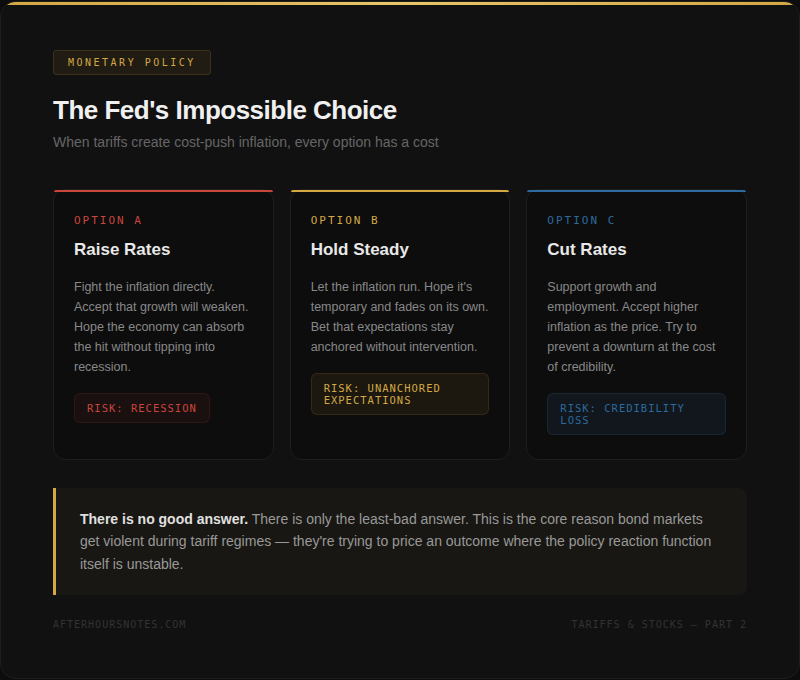
There is no good answer. There is only the least-bad answer. This is why bond markets get violent during tariff regimes.
Read that again. It matters. There is no good answer. This is why bond markets get violent during tariff regimes cause they’re trying to price an outcome where the policy reaction function itself is unstable.
Now let’s get to the part that almost nobody explains properly: inflation expectations and how markets infer them.
Inflation expectations are what investors, businesses, and consumers believe future inflation will be. This sounds like a soft concept but it’s actually one of the most important variables in the whole financial system. Here’s why- if everyone expects 5% inflation, workers will demand 5% raises, landlords will write 5% rent escalators into leases, businesses will build 5% price increases into their pricing models. Those actions, taken together, produce 5% inflation even if the original cause of the expectation has gone away. Expectations become self-fulfilling.
This is what economists mean by inflation expectations becoming “unanchored.” Anchored expectations mean people trust the Fed will keep inflation near 2%, so they plan around 2%, so inflation stays near 2%. Unanchored expectations mean people no longer trust that, so they plan around higher numbers, so inflation runs higher. Once you lose the anchor, getting it back requires brutal policy. Paul Volcker raising rates to 20% in the early 1980s to break the previous unanchoring is the historical reference point. Nobody wants to do that again.
How Markets Actually Measure Inflation Expectations
So how do you measure something as squishy as expectations? Markets give you a clean readout, and this is where the analysis gets useful.
The US Treasury issues two kinds of bonds: regular Treasuries (which pay a fixed dollar amount) and Treasury Inflation-Protected Securities, called TIPS (which pay an amount that adjusts upward with inflation). If a regular 10-year Treasury yields 4.5% and a 10-year TIPS yields 2.0%, the gap between them- 2.5% is what markets implicitly expect inflation to be over the next ten years. This gap is called the breakeven inflation rate, and it updates second by second as bonds trade.
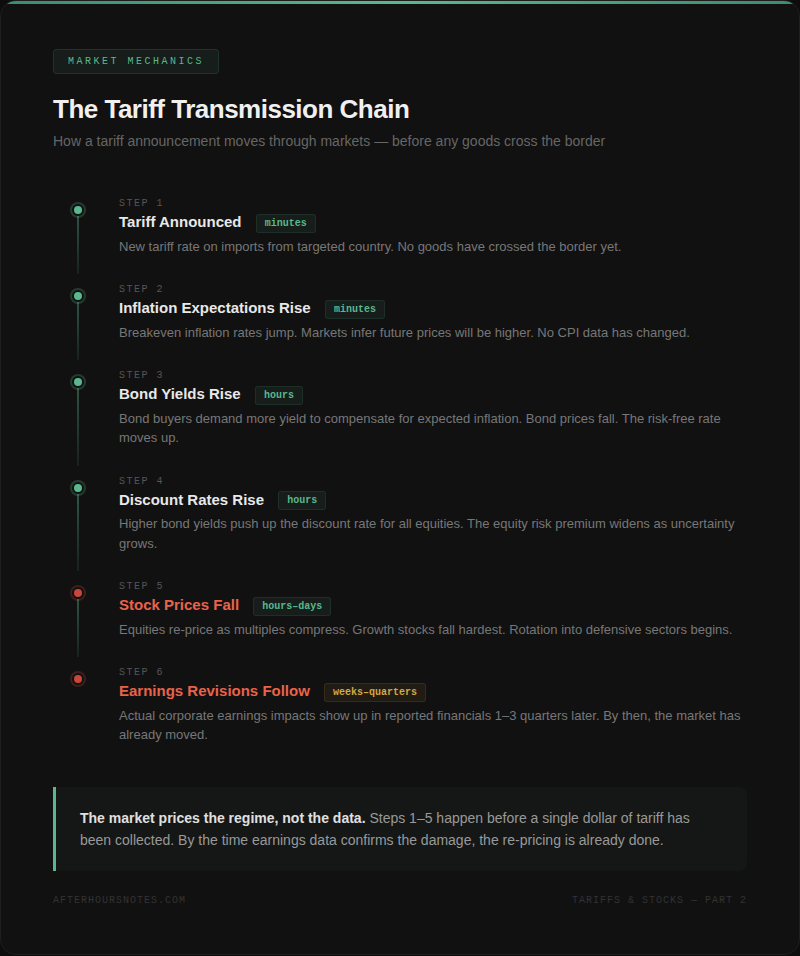
When tariffs are announced, you can literally watch breakeven inflation rates jump in real time. The market doesn’t wait for CPI data. It infers, immediately, that future inflation will be higher than previously expected, and bond prices adjust within minutes. This is the cleanest, fastest signal of how markets are processing tariff news.
The April 2025 selloff was a textbook example. The move in 5-year breakevens told you more than the move in equities did. Equities can fall for a dozen reasons. Breakevens moving sharply higher tell you specifically that the market is pricing more inflation, which then forces a re-pricing of everything else.
Now we connect this to bond yields. Why does higher expected inflation cause bond yields to rise mechanically?
Why Bond Yields Rise — The Actual Mechanics
Think about it from the perspective of someone buying a 10-year bond. You’re lending money to the government today and getting fixed dollar payments back over the next decade. If inflation runs at 2%, your dollars in year ten are worth roughly 82% of what they’re worth today (because of cumulative price increases). If inflation runs at 5%, those future dollars are worth only 61% of today’s dollars. The bond pays you the same nominal amount in both cases, but the real value- what you can actually buy with the money is much lower under high inflation.
So if you’re a bond buyer and you suddenly believe inflation will be higher than you thought, you demand a higher yield to compensate. Either the bond’s price falls (which raises its yield to new buyers) or nobody buys it at the old price. Either way, yields rise.
This is the mechanism. Tariff announced → expected inflation rises → bond buyers demand more yield → bond prices fall, yields rise → and now, critically, that rise in yields gets transmitted into the discount rate that equity investors use to value stocks. Stocks fall. The chain is mechanical. It doesn’t require any actual inflation to have happened yet.
There’s one more concept to unpack here because it’s central to understanding the bond market reaction: term premium.
When you buy a 10-year bond, you’re not just being compensated for expected inflation. You’re also being compensated for the risk that inflation turns out differently than you expected- that it surprises higher, or that it becomes more volatile, or that some unforeseen shock disrupts your assumptions. This extra compensation, on top of the basic inflation premium, is called the term premium. It’s the price of bearing uncertainty about the future.
Tariff regimes push term premium higher because they make the inflation outlook more uncertain. Even if your central estimate of inflation hasn’t changed much, the range of possible inflation outcomes has widened. Bond investors demand to be paid for that widened range. So long-dated yields rise even more than the change in expected inflation alone would justify. This is why during tariff episodes you typically see the yield curve steepen that is long yields rise faster than short yields, because term premium is mostly priced in the long end.
The Fed watches all of this in real time. Their policy reaction function- the rule by which they translate economic conditions into rate decisions has to absorb tariff effects across multiple channels simultaneously: actual inflation data, inflation expectations, growth indicators, financial conditions, and the structural assessment of whether the tariff shock is temporary or persistent. There’s no clean answer. There’s just judgment under uncertainty, in front of cameras, by humans who know they’ll be blamed regardless of outcome.
The Death of the Fed Put
This is why “Fed put” expectations get challenged during tariff regimes. The Fed put is the market’s belief that the Fed will cut rates aggressively if asset prices fall enough. That belief depends on the Fed having room to cut which it has when inflation is low. When tariffs push inflation higher, the Fed loses that room. Suddenly the put is harder to exercise. The market notices. Risk premia widen. Volatility rises. The reflexive feedback loop between policy expectations and asset prices becomes a source of instability rather than stability.
The practical implication for portfolio construction: during tariff regimes, the historical playbook of “stocks down → Fed cuts → stocks recover” stops working reliably. The Fed may be constrained from cutting even when growth weakens. This breaks one of the most important assumptions retail investors have built up over the post-2008 era. Anyone who learned to “buy the dip” in a world of unconstrained monetary policy needs to update their priors when the monetary policy is now constrained.
Alberto Cavallo runs a live tariff price tracker at pricinglab.org that updates with actual retail price data across tariffed product categories. Faster signal than waiting for monthly CPI prints.
TARIFFS AND EQUITY VALUATIONS
Now let’s go deeper on something we touched on earlier- how stocks can fall even when earnings hold up. This is the part nobody warns retail investors about, and it’s where the real damage in tariff regimes often hides.
We established the master valuation equation in Part 3: stock value equals expected future profits divided by a discount rate. We talked about how both sides move when tariffs hit. Let’s now do the math more carefully, because the magnitudes are larger than most people realize.
Start with a simple stock. It earns $5 per share, growing at 4% per year. Investors discount future earnings at 8%. Using a standard growth model, the stock is worth approximately:
$5 / (8% – 4%) = $125Now suppose tariffs hit. Expected earnings growth slows from 4% to 3% (modest impact). The discount rate rises from 8% to 9% (mostly from higher bond yields and slightly wider risk premium). The new value:
$5 / (9% – 3%) = $83The stock just fell from $125 to $83 a 33% decline and current earnings haven’t moved at all. The drop came entirely from two small changes in the inputs: 1% slower expected growth, 1% higher discount rate. Together they produced a one-third reduction in the stock’s value.
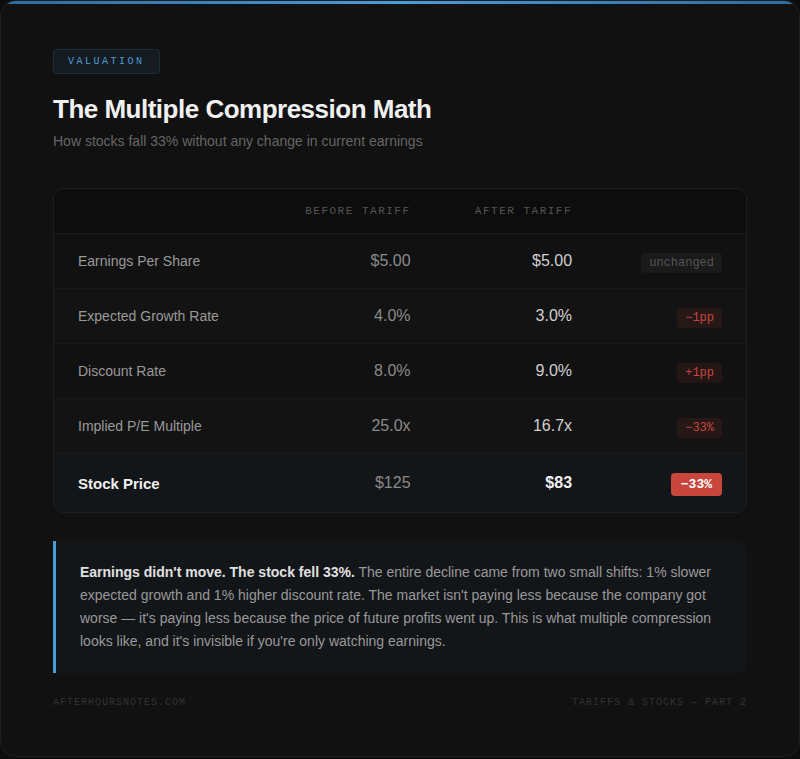
This is what professionals mean when they say tariffs cause multiple compression, and now you can see why it matters so much. The multiple the P/E ratio is just a shorthand for the relationship between price and earnings. When the discount rate goes up and growth expectations come down, the multiple has to come down too, even before any actual earnings degradation appears in reported financials.
The brutal part: investors looking at the company quarter to quarter see normal earnings, no warning signs, business as usual. The stock just keeps drifting lower and they can’t understand why. The “why” is buried in valuation math they’re not running. The discount rate is doing the damage silently.
What’s Actually Inside the Discount Rate
Let’s unpack each piece of the discount rate more precisely so you can see what’s actually moving.
The risk-free rate. This is the yield on long-dated government bonds, which we already covered. When tariffs push bond yields up, the entire foundation of the discount rate moves up with them. Every stock in the market gets re-priced.
The equity risk premium. This is the extra return investors demand for owning stocks instead of bonds. It’s not directly observable you have to infer it from market prices, but it captures everything investors are worried about uncertainty about earnings, risk of recession, geopolitical instability, regulatory shocks. Tariffs widen the range of possible outcomes for the corporate sector, which means the risk premium has to rise to compensate investors for bearing that wider range.
In normal times the equity risk premium runs around 4-5% above bond yields. In tariff-stressed regimes it can widen by 50-150 basis points. That widening alone without any change in earnings produces double-digit declines in equity values for high-multiple stocks.
Earnings visibility. This isn’t a separate component of the discount rate technically, but it interacts with everything else. When companies can’t reliably forecast their own next-quarter earnings which is what happens during tariff regimes, because too many variables are moving, analysts can’t reliably forecast them either. Earnings estimates become more dispersed. The “earnings yield” investors are buying becomes fuzzier. The market responds by paying less for that fuzzier yield.
Why Growth Stocks Get Hit Hardest
The companies that suffer the most multiple compression are the ones whose valuations were built on high growth expectations. Here’s why. A stock trading at 30x earnings is essentially a bet that the company will keep growing fast for a long time. Most of the value of that stock isn’t in next year’s earnings but it’s in the earnings ten, fifteen, twenty years from now. Those distant earnings get heavily affected by even small changes in the discount rate, because the discounting compounds over time.
A stock trading at 10x earnings has a different value structure. Most of its value is in the near-term earnings stream. The discount rate matters less because there’s less compounding to do.
The practical consequence: during tariff regimes, high-multiple growth stocks get punished disproportionately, even if their actual businesses aren’t directly tariff-exposed. A software company with no physical imports can lose 30% of its market cap during a tariff scare. The cause isn’t tariffs hitting its business. The cause is the discount rate going up, and the math of long-duration cash flows being sensitive to discount rates.
This is what professionals mean when they say tariffs cause a “rotation” in markets. Money flows out of high-multiple, long-duration assets (growth stocks, tech, anything priced on distant earnings) and into low-multiple, short-duration assets (value stocks, banks, energy, anything priced on near-term cash flows). The rotation isn’t about fundamental performance. It’s about which kinds of assets are most sensitive to discount rate moves. The companies in the first group don’t have to do anything wrong to underperform, they just have to keep being long-duration assets while rates are rising.
There’s a subtler effect that compounds this- the uncertainty premium on optionality. A lot of growth-stock valuation depends on the company having future options– the option to expand into new markets, launch new products, scale into adjacent businesses. These options have value, and that value gets included in the stock price. But options are worth more when the future is predictable, and worth less when the future is volatile. Tariff regimes make the future less predictable. Options get marked down. Growth-stock multiples compress further.
The Rotation Trade
The mirror image is what happens to “defensive” stocks- consumer staples, utilities, healthcare. These businesses generate stable cash flows that don’t depend much on policy uncertainty. During tariff regimes, their relative attractiveness rises, not because they get better but because everything else gets worse. They become the place to hide. Their multiples often expand even as growth-stock multiples compress.
Remember this: stocks can fall hard during tariff regimes for reasons that have nothing to do with the affected company’s actual business. The discount rate is doing most of the work. Watching earnings for explanation is watching the wrong variable.
Stocks can fall hard during tariff regimes for reasons that have nothing to do with the affected company’s actual business. The discount rate is doing most of the work.
SECTOR WINNERS AND LOSERS
Now the practical question. Which sectors actually win and which lose? The simple answer you hear in financial media is wrong about half the time. Let’s do this properly.
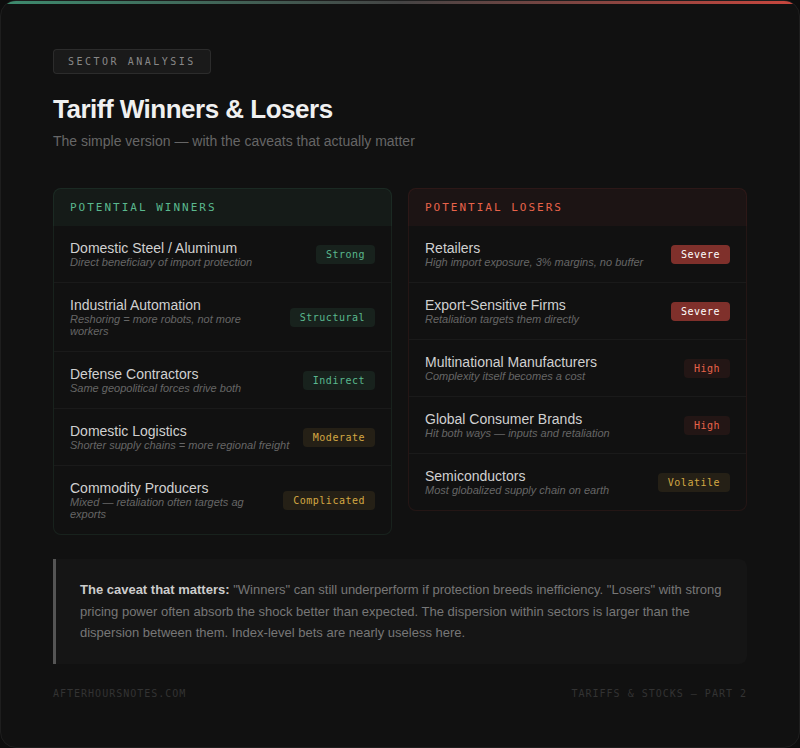
The naive framing goes: tariffs protect domestic industries, so domestic manufacturers win and importers lose. This framing is right at the cartoon level and wrong at the analytical level, and the gap between the two is where the actual investment performance lives.
The Winners (With Caveats)
Let’s go through the sectors one at a time, starting with the ones the cartoon gets approximately right. Let’s see how tariffs and inflation affect various sectors
Domestic manufacturers – companies that make goods inside the tariff-imposing country, selling primarily to domestic customers, using primarily domestic inputs are the textbook tariff winners. Their foreign competition just got more expensive, which gives them pricing power and potential market share gains.
But here’s the catch the cartoon misses. Most “domestic manufacturers” aren’t actually domestic in their inputs. A US steel mill imports specialty alloys it doesn’t make. A US automaker imports thousands of components. A US chemical company imports specialty inputs from Germany. When you look at how supply chains actually work, very few firms are purely domestic. They benefit from tariffs on competitor’s finished products but get hurt by tariffs on their own inputs.
The companies that genuinely benefit are the ones that combine three traits: they sell into a domestic market where foreign competition matters, their input chain is mostly domestic or from non-tariffed countries, and they have the capacity to ramp production to meet shifted demand. Most US Steel-style integrated producers fit this profile. Many “domestic” manufacturers don’t.
Industrial automation companies are a real win, and the reason is interesting. When companies reshore production, they don’t reshore the labor-intensive cost structure of 1990s manufacturing. Labor in developed countries is too expensive for that. Instead, they reshore with much heavier automation like robots, programmable controls, AI-driven quality systems. The companies that sell that equipment names like Rockwell, Emerson, Honeywell on the industrial side, plus a long tail of robotics specialists benefit structurally from the reshoring trend whether or not any specific tariff sticks.
Defense contractors benefit because tariff regimes typically coincide with broader geopolitical fragmentation, which means rising defense budgets. The link isn’t direct; it’s that the same political forces driving tariffs also drive defense spending. Companies like Lockheed, Raytheon, General Dynamics tend to outperform during these regimes for reasons that have little to do with tariffs themselves.
Domestic logistics– railroads, trucking, intermodal infrastructure benefit when supply chains shift from long ocean routes to shorter regional routes. Mexico-to-US trucking, for example, expanded enormously during the 2018-2024 supply chain reshuffling. Domestic rail volumes pick up when manufacturing moves closer to consumption.
Commodity producers are a complicated case. Tariffs on specific commodities (steel, aluminum) help domestic producers of those commodities. But broader commodity producers (oil, gas, agricultural products) can get hurt by tariff regimes because retaliatory tariffs from trading partners often target agricultural and energy exports. US soybean farmers learned this the hard way in 2018.
The Losers (Worse Than You Think)
Now the losers, and here the standard framing gets the direction right but understates the magnitude. Tariffs and inflation affect the losers in ways you won’t usually think about.
Retailers are the most direct victims. They import enormous quantities of goods, have weak pricing power (they compete on price), and have low margins to absorb cost shocks. A 25% tariff on imported consumer goods is potentially fatal for retailers operating on 3% net margins. Walmart and Costco have the scale to negotiate better terms with suppliers and partially offset the impact. Smaller retailers and specialty chains often don’t. The 2018-2019 cycle saw widespread bankruptcies in retail that were partially attributable to tariff cost pressures.
Semiconductors are a special case worth careful analysis. The semiconductor industry is the most globalized supply chain on earth- chips designed in California, manufactured in Taiwan or Korea, packaged in Malaysia or Vietnam, integrated into products in China. Tariffs on any node in this chain create cascading effects through the rest. But tariff effects on semis are also offset by enormous government subsidies (CHIPS Act in the US, similar programs in EU and Asia) that compensate for some of the cost. Net effect: high volatility, big dispersion between winners and losers within the sector, hard to make a clean directional bet.
Multinational manufacturers with extensive global supply chains face the most complex impact. They have offsetting exposures, so they benefit from tariffs protecting their domestic operations, suffer from tariffs on their imported components, gain from FX adjustments in some markets, lose from retaliatory tariffs in others. The net effect is usually negative because complexity itself is expensive. The cost of constantly reconfiguring supply chains, the working capital tied up in larger inventory buffers, the management bandwidth consumed by trade compliance these all hit margins.
Global consumer brands that sell across borders get hit two ways. Their imported components become more expensive (input cost shock), and retaliatory tariffs in foreign markets make their products more expensive there (revenue shock). Companies like Apple have the scale and the brand strength to absorb a lot of this. Smaller brands with thinner moats often can’t.
Export-sensitive firms are the cleanest losers. These are companies whose revenue depends on selling into foreign markets that will impose retaliatory tariffs. Boeing and US agricultural processors are classic examples. They don’t import much, so they don’t benefit from the domestic protection effect. They sell abroad, so they get hit by retaliation. There’s no offset.
Now the most important point, which standard financial media almost never makes: protected industries often become inefficient.
The Dirty Secret: Protection Breeds Inefficiency
📄 The research
Fajgelbaum et al. found that import tariffs were politically targeted — they protected products made in swing counties. But the retaliatory tariffs hit hardest in deeply Republican agricultural counties. The constituencies that voted for tariff protection were the most damaged by the retaliation it provoked. (QJE, 2020)
This is the dirty secret of tariff protection. When you shield a domestic industry from foreign competition, you give it pricing power and time. The companies use that time and pricing power in different ways depending on management quality and competitive structure. The best companies use it to invest in productivity improvements, R&D, and capacity expansion — they emerge from the protection period stronger. The worst companies use it to maintain profit margins on outdated technology, return cash to shareholders, and delay necessary modernization. They emerge weaker, having lost ground to global competitors who continued investing.
The 1980s US steel industry is a textbook case. Massive tariff protection allowed integrated steel producers to maintain high prices and high margins for years while underinvesting in modernization. Then the protection ended (partially), and a generation of integrated producers got destroyed by mini-mills using newer technology. The protection didn’t save them. It just delayed the reckoning and made it worse when it came.
The investment implication: domestic winners benefit in the short run from tariff protection but can underperform in the long run if the protection breeds inefficiency. The stocks that ultimately win are the ones where management uses the protection period aggressively to build durable competitive advantages, not the ones that just collect the short-term margin gains. Distinguishing between the two requires actual fundamental analysis of management quality and strategic direction.
Where the Edge Actually Lives
There’s one more dimension worth flagging: expectations vs. reality. By the time a tariff is announced, the market has often already priced in the expected winners and losers based on initial assumptions. The actual investment edge comes from identifying where those initial assumptions are wrong, where a presumed winner is actually a hidden loser because of supply chain exposure analysts missed, or where a presumed loser has more pricing power or geographic flexibility than the consensus appreciates.
Index-level analysis is useless here. The dispersion inside sectors is enormous, and the alpha lives in the gaps between consensus expectations and reality. This is why tariff regimes are typically good environments for active stock pickers and bad environments for passive index investors. The market is throwing massive idiosyncratic opportunities, but only for people doing the actual work to find them.
SUPPLY CHAIN FRAGMENTATION
We’ve talked a lot about tariffs as taxes. Now let’s talk about what tariffs and inflation really do structurally to the global economy because the deeper effect isn’t the cost increase on imported goods. It’s the reorganization of how production happens at all.
For thirty years, global supply chains optimized for one thing: cost. If a component could be made for $0.10 less in another country, production moved there. If a final assembly step could happen $1 cheaper somewhere else, the assembly moved. The result was supply chains of extraordinary complexity- a typical car has parts that crossed national borders multiple times before reaching the assembly plant, each crossing chosen to minimize unit cost.
The Hidden Cost of Efficiency
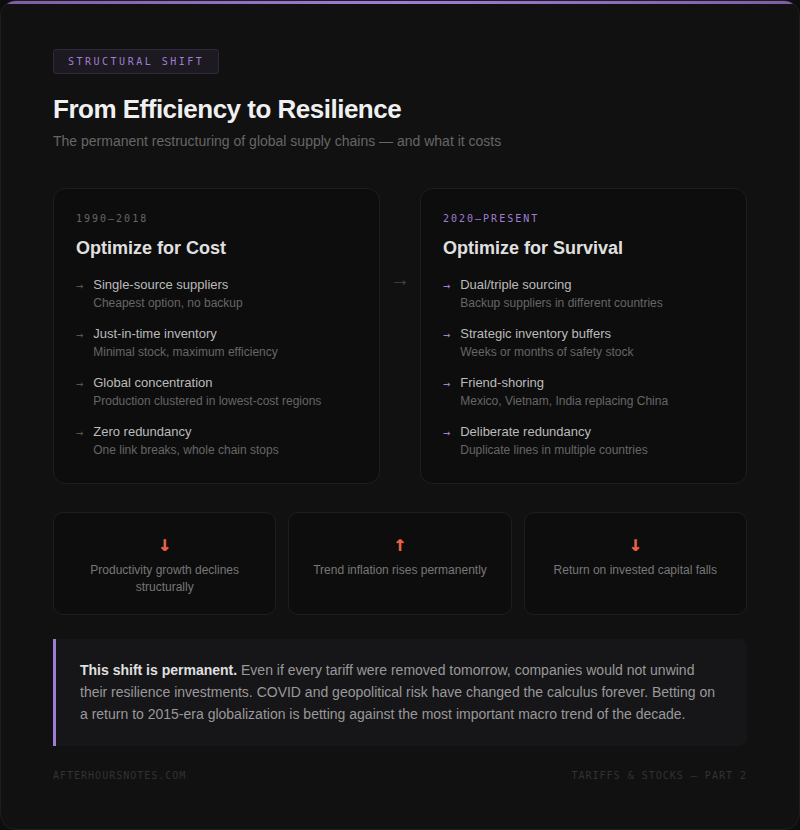
This cost-minimizing structure had hidden costs that nobody priced. It had no slack. No backup suppliers, no excess inventory, no redundant capacity. If any one link broke, the whole chain stopped. COVID exposed this in 2020- single factory shutdowns in Wuhan cascaded into shortages across global manufacturing within weeks.
The post-COVID, post-tariff response is a fundamental restructuring of supply chains around different priorities: resilience, redundancy, and geographic diversification. The buzzwords are familiar- reshoring, nearshoring, friend-shoring but the underlying economic shift is profound. Companies are now willing to pay 10-20% more in unit costs to have backup suppliers, alternate manufacturing locations, and inventory buffers. They’re willing to do this because they’ve learned that the 10-20% premium is cheaper than the cost of a supply chain failure.
The Reshuffling in Real Numbers
This restructuring shows up in real numbers. Mexico has overtaken China as the largest source of US imports. Vietnam, India, and Indonesia are absorbing manufacturing that previously concentrated in China. Companies are building duplicate production lines in different countries so they can shift volume between them if any one location becomes politically or operationally problematic.
The economic consequence is that productivity declines structurally. Here’s why. The old system was efficient it produced more output per dollar of capital invested. The new system is less efficient it requires more capital (multiple facilities), more inventory (working capital buffers), more labor (less specialization), and more management overhead (coordinating complex multi-country operations). Each unit of output now costs more to produce than it did under the old system.
This is not a temporary phenomenon. It’s a permanent shift in the productivity frontier of the global economy. When productivity growth slows, two things happen: trend growth slows, and trend inflation rises. Both of these are structurally unfavorable for asset prices.
Why does slower productivity mean higher inflation? Because productivity growth is one of the main forces that keeps prices down over time. When workers can produce more output per hour, their wages can rise without firms needing to raise prices, the productivity gains pay for the wage gains. When productivity growth slows, wage increases have to be paid for by price increases. The cost-push effects of tariffs reinforce themselves through this productivity channel, producing inflation pressures that persist long after the original tariff shock has been absorbed.
This is the part that makes central bankers nervous. Cyclical inflation from a one-time tariff shock can be handled- it works through the system, prices adjust, the disturbance fades. Structural inflation from a permanent productivity slowdown is much harder to manage. The Fed can’t fix slow productivity with interest rate policy. All it can do is keep rates higher than they would otherwise be to prevent the structural inflation from getting embedded in expectations.
Inventory, Working Capital, and the Permanent Cost
There’s another dimension that gets underappreciated: inventory rebuilding. Under just-in-time supply chains, companies held very little inventory. The new resilience-focused approach requires holding much more. This is a one-time transition cost. Companies have to build up inventory levels, which ties up working capital and produces a temporary boost to industrial demand as the buildup happens. But it’s also a permanent change in the cost structure. Higher steady-state inventory means more capital tied up indefinitely, which lowers return on invested capital across the corporate sector.
Reshoring and friend-shoring deserve careful distinction. Reshoring means moving production back to the home country. This is rare in practice because the home country usually has much higher labor costs. What’s more common is friend-shoring — moving production from a geopolitical rival (like China) to an allied or neutral country (like Mexico, Vietnam, Poland). This achieves the strategic objective of reducing dependence on the rival without absorbing the full cost increase of moving to the home country.
Where the Money Is Actually Moving
Friend-shoring has been the dominant pattern of supply chain reorganization since 2018, and the data shows it clearly. Mexico’s manufacturing exports to the US have grown dramatically. Vietnam has absorbed enormous flows of electronics manufacturing. India is now a major destination for everything from semiconductors to pharmaceuticals. The losers, in terms of share of global manufacturing, are concentrated in China — and increasingly in countries that have aligned themselves with China geopolitically.
This reorganization creates investment opportunities and risks that aren’t obvious from headline-level analysis. Mexican industrial real estate has been one of the best-performing asset classes globally over the past five years, largely because of the friend-shoring trend. Vietnamese equity has had moments of significant outperformance. Indian industrial conglomerates have benefited. The flip side is that Chinese manufacturing equity has chronically underperformed despite reasonable valuations, because the structural force of supply chain rerouting is working against it.
The deeper point: supply chain fragmentation isn’t a temporary response to specific tariffs. It’s a permanent feature of the new economic regime. Even if specific tariffs were removed tomorrow, companies wouldn’t unwind their resilience investments. The memory of COVID and the geopolitical uncertainty are themselves enough to justify maintaining the more redundant, less efficient structure.
“Supply chain fragmentation isn’t a temporary response to specific tariffs. It’s a permanent feature of the new economic regime.”
This is why “tariffs will be reversed by the next administration” is a weak investment thesis. The political conditions that produced the tariffs are themselves the product of deeper forces like geopolitical fragmentation, security concerns, distributional politics that aren’t going away. Specific tariff rates may rise and fall. The structural shift toward less efficient, more resilient supply chains is durable. Markets are slowly pricing this. Anyone betting on a return to the 2015 globalization regime is betting against the most important macro trend of the decade.
Subscribe for Part 3 that will be released soon!