What Citrini got right, what Citadel got right, and the specific thing both sides refused to look at
There’s a kind of economic growth that shows up in the GDP report and nowhere else in the real economy not in paychecks, not in consumer spending, not in small business formation. Citrini Research calls it Ghost GDP, and it’s the single idea that actually matters from the most contested AI debate of 2026 even after the headlines about it have faded.
Twenty-two million views. That is what it takes, apparently, to get Wall Street to argue about unemployment on a Tuesday afternoon.
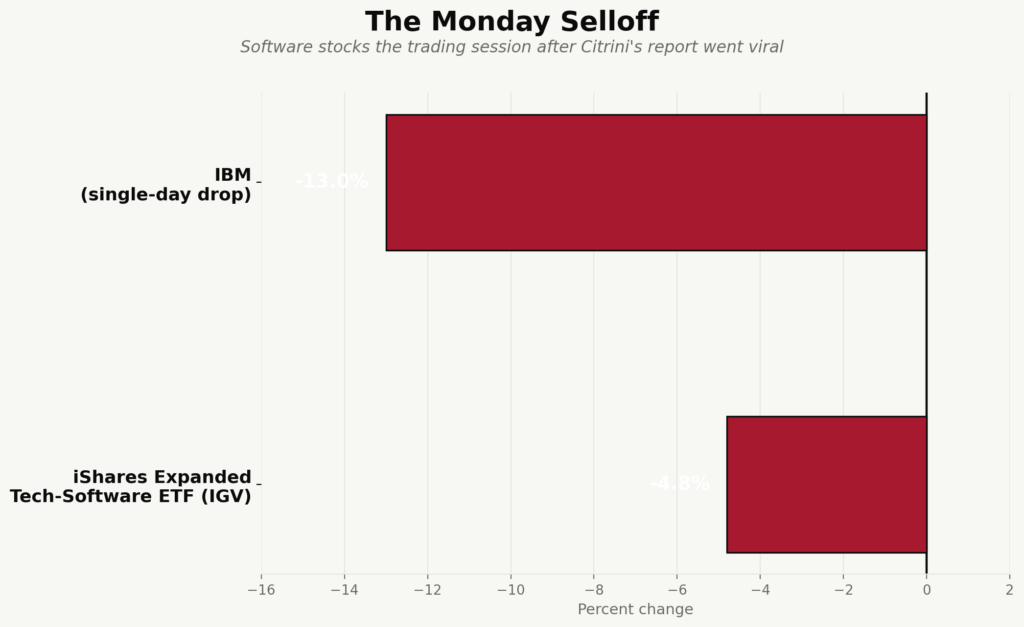
On February 22, 2026, Citrini Research published “The 2028 Global Intelligence Crisis,” co-written by James van Geelen and Alap Shah. It went viral in a way that financial research almost never does, shared by economists, traders, engineers, policy staffers, and people who have never read a sell-side note in their lives. Michael Burry amplified it. By Monday morning, software stocks were selling off sharply. IBM fell 13% on a single day when Anthropic released a new tool, with the Citrini piece providing the macro narrative for the panic. The iShares Expanded Tech-Software ETF fell 4.8% in a single session. The Financial Times was quoting it. LinkedIn was flooded with takes from people who had spent two hours becoming AI labor economists.
Four days later, Citadel Securities- one of the largest liquidity providers in global markets, built by Ken Griffin into one of the most analytically rigorous institutions in finance published a direct rebuttal authored by global macro analyst Frank Flight. The debate had a second act.
Here is the thing about that debate: both sides lost.
Not because they were sloppy. Not because the research was weak. Because both Citrini and Citadel were answering different questions and calling it the same debate. Citrini described an endpoint a fully realized 2028 where the displacement spiral has already closed. Citadel described a current moment a 2026 where the data is stable and adoption trends are linear. Neither of them described the path between the two: the transition mechanism, the sector-by-sector sequence, the quarter-by-quarter progression through which you get from here to there.
That transition is the whole game. And nobody has mapped it.
This piece maps it.
The central claim, stated plainly: White-collar displacement from AI does not arrive as a shock. It arrives as a sequence a specific ordering of job categories, across specific industries, that moves faster than the policy apparatus can respond and slower than the doom narrative implies. That sequence is already underway. The signal exists in the data right now. But because of how the Bureau of Labor Statistics classifies employment, how GDP accounting works, and how markets are built to measure equilibrium states rather than transitions, the aggregate numbers will look fine right up until they don’t. Citrini called the final destination correctly. Citadel called the current location correctly. Neither of them drew the route. We are somewhere in the middle of that route right now, and the market has no map.
February 2026: The Week a Substack Post Moved Markets
To understand what Citrini and Citadel were actually arguing, you need to understand the moment they were arguing in.
Citrini framed the piece explicitly as “a scenario, not a prediction”- a thought exercise written as a fictional macro memo from June 2028, looking back at the crisis that unfolded. The opening line: “The unemployment rate printed 10.2% this morning, a 0.3% upside surprise. The market sold off 2% on the number, bringing the cumulative drawdown in the S&P to 38% from its October 2026 highs.”
That framing — specific numbers, specific dates, written in the past tense from an imagined future is what made the piece travel. It did not feel like a prediction. It felt like a post-mortem. And post-mortems, when they describe something still preventable, are the most unnerving kind of writing.
The piece asked a question that nobody in the consensus was asking: “What if our AI bullishness continues to be right…and what if that’s actually bearish?” Not AI fails to deliver. AI succeeds completely and that success is what breaks the economy.
This is a genuinely uncomfortable question. It is uncomfortable because it cannot be dismissed with the standard rebuttal (”AI will create new jobs, it always has”). It is uncomfortable because the mechanism is internally coherent. It is uncomfortable because it does not require anything unusual to happen just a continuation of trends already in place.
Citadel responded four days later, and the tone was sharp. Frank Flight opened with a mirror image of Citrini’s fictional present-tense: “The year is 2026. The unemployment rate just printed 4.28%, AI capex is 2% of GDP ($650bn), AI adjacent commodities are up 65% since Jan-23 and approximately 2,800 data centers are planned for construction in the US. In spite of the current displacement narrative job postings for software engineers are rising rapidly, up 11% YoY.”
The implicit message: you want present-tense drama? Here is the actual present. It looks nothing like your scenario.
Both pieces are worth reading carefully, which is why both are reproduced in full elsewhere. What follows is not a summary. It is an analysis of the specific things each side got right, the specific things each side got wrong, and the specific gap between them that neither side addressed.
What Citrini Got Right: The Mechanism Is Real
Start with Citrini, because the core mechanism the one that drove twenty-two million views deserves full treatment. Not a caricature of it. The actual argument.
What Is Ghost GDP?
Ghost GDP. This is the concept at the center of the piece, and it is worth explaining from scratch because most people who cite it do not fully understand what it means.
GDP — Gross Domestic Product measures the total value of goods and services produced in an economy during a period of time. The calculation does not care who or what produced the output. A dollar of revenue generated by a software agent running on a GPU cluster counts identically to a dollar of revenue generated by a human analyst. Measured GDP goes up either way.
Here is the problem. The human analyst earns a salary. That salary gets spent on rent, groceries, restaurant meals, childcare, weekend flights, streaming services. That spending is someone else’s revenue, which funds their salary, which gets spent again. Economists call this the velocity of money: a single dollar, as it circulates through the economy, generates multiple dollars of total economic activity. The precise relationship depends on how many times each dollar changes hands before it stops moving.
A GPU cluster does not earn a salary. The revenue it generates flows to the company’s owners and capital providers overwhelmingly the top quintile of income distribution, the people who hold most financial assets. Some of that becomes dividends and buybacks. Some becomes retained earnings reinvested in more compute. None of it becomes a paycheck that a 34-year-old spends at a restaurant in Austin.
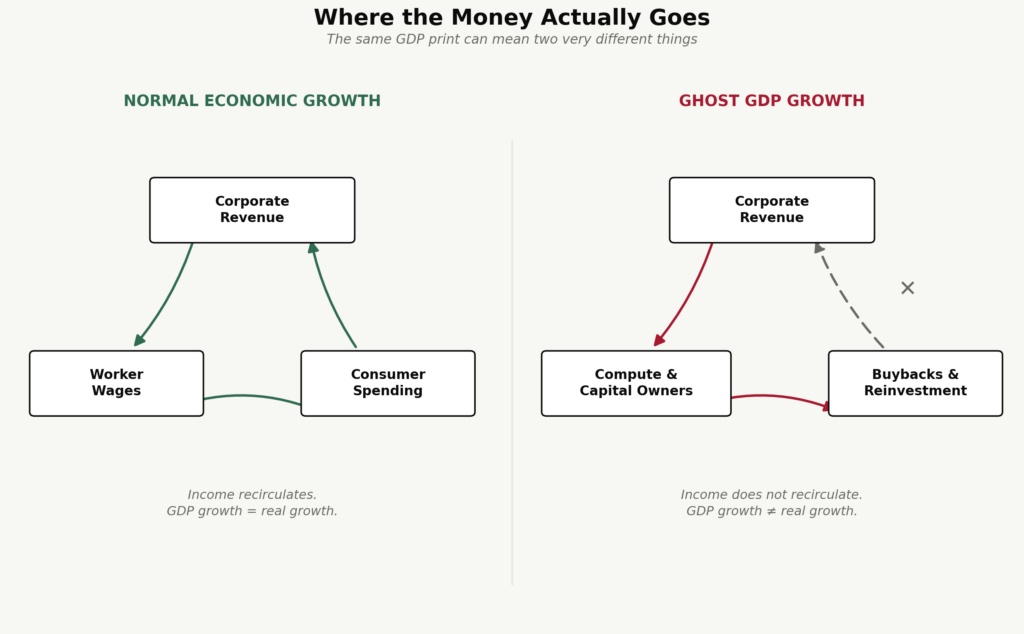
Citrini named this gap precisely: a single GPU cluster in North Dakota generating the output previously attributed to 10,000 white-collar workers in midtown Manhattan is “more economic pandemic than economic panacea.” The velocity of money flatlines. The human-centric consumer economy which contributes 70% of GDP withers.
Ghost GDP is what you get when measured output rises but the income that would normally circulate through the real economy does not accompany it. GDP goes up. Velocity goes down. Consumer spending starts to disconnect from the headline number. The macro data looks fine. The underlying circulation is quietly impaired.
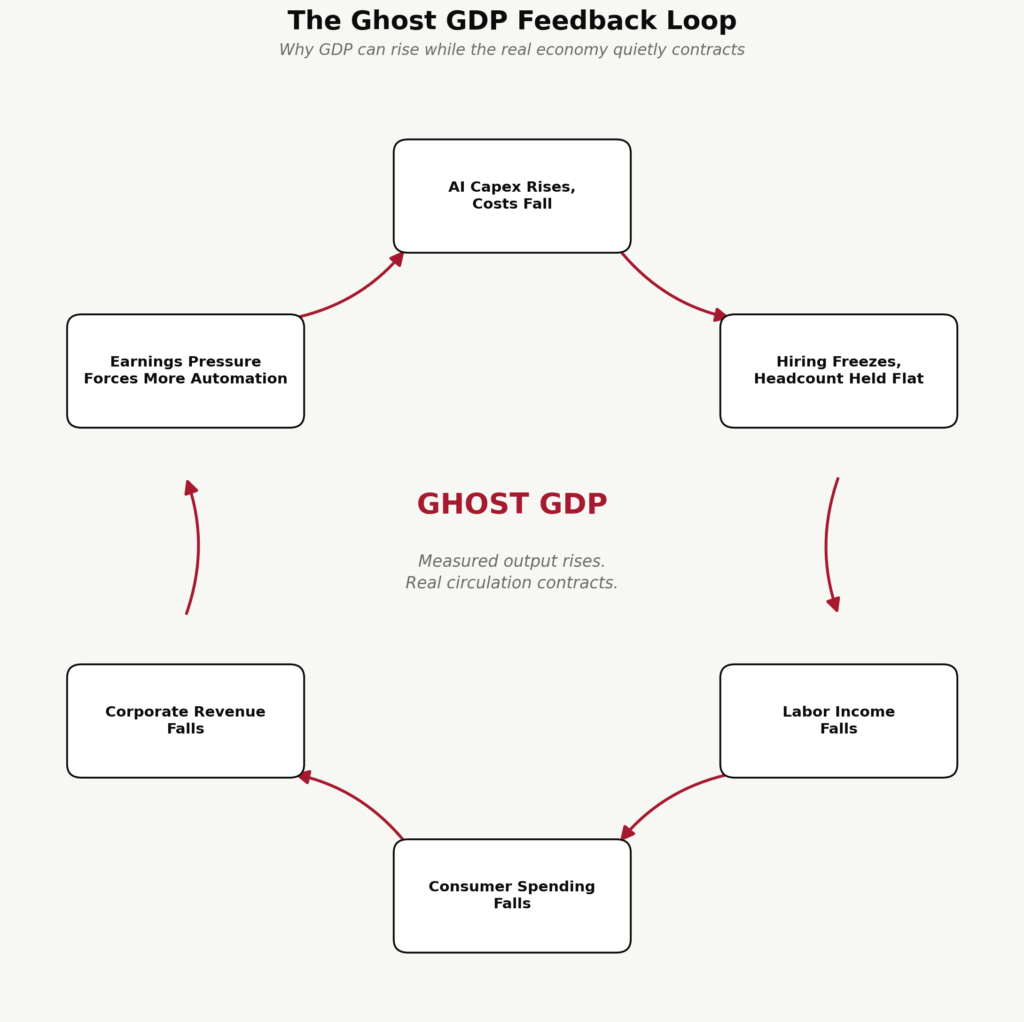
To make this concrete: imagine a mid-sized consulting firm that replaces forty junior analysts each earning $80,000 per year with an enterprise AI subscription costing $2 million annually. Costs fall by $1.2 million. Margins improve. Stock goes up. Measured GDP absorbs the firm’s output at the same value as before. Nothing in the national accounts registers the change. But those forty analysts were spending their salaries. That $3.2 million in annual wages was not sitting in a vault. It was circulating. When it stops, the downstream chain- the landlords, the dry cleaners, the restaurants those analysts frequented never sees it.
There is a concept in macroeconomics called the consumer spending multiplier that makes this feedback loop more powerful than it looks on paper. The multiplier captures the idea that one dollar of additional income generates more than one dollar of economic activity, because the recipient spends some of it, the recipient of that spending spends some of theirs, and so on. For wage income particularly for middle and lower-income households, who spend a higher share of each marginal dollar the multiplier is estimated somewhere between 1.5 and 2.0. One dollar of wages generates one-fifty to two dollars of total economic activity.
The flipside is equally true and equally mathematical. One dollar of wage income destroyed reduces GDP by one-fifty to two dollars, because the downstream spending chain collapses too. Run that math across hundreds of thousands of displaced white-collar workers over several years not all at once, but in a sequence and the cumulative withdrawal from aggregate demand is significantly larger than the raw displacement numbers suggest.
“Ghost GDP is the most dangerous kind of growth: it shows up in national accounts and nowhere else.”
The Citrini piece traces the full cascade with specific examples: ServiceNow announcing a 15% workforce reduction as AI cuts into their own client headcount, destroying the seat-based revenue model. DoorDash’s habitual intermediation moat (”you’re hungry, you’re lazy, this is the app on your home screen”) being irrelevant to an agent that checks twenty platforms simultaneously. Mastercard watching agentic commerce route around interchange fees toward stablecoins. Life insurers like Apollo’s Athene, Brookfield’s American Equity, KKR’s Global Atlantic sitting on private credit portfolios where the underlying SaaS borrowers’ ARR had stopped being recurring.
Each step of that chain is mechanically sound. The ServiceNow example is particularly sharp: the company selling workflow automation gets disrupted by better workflow automation, responds by cutting headcount and funding AI tools with the savings, which accelerates the very disruption threatening it. Individual rationality, collective catastrophe. Citrini names this correctly.
The piece also correctly identifies why monetary policy cannot fix this. As Citrini wrote: “The traditional policy toolkit (rate cuts, QE) can address the financial engine but cannot address the real economy engine, because the real economy engine is not driven by tight financial conditions. It’s driven by AI making human intelligence less scarce and less valuable. You can cut rates to zero and buy every MBS and all the defaulted software LBO debt in the market… It won’t change the fact that a Claude agent can do the work of a $180,000 product manager for $200/month.”
This is not a demand shock. A demand shock is when people stop spending because they are uncertain or over-leveraged, and the cure is to make borrowing cheaper. A displacement-driven deflationary feedback loop destroys the income that funds demand. Rate cuts do not recreate income. This is the specific thing the Fed is not built to fix, and it matters enormously for how you think about the policy response and the bond market. We will return to this in Part 3.
The Citrini mechanism is real. The direction is right. The internal logic is consistent. Every link in the chain is defensible.
Where Citrini goes wrong is in the timing, the linearity, and the implicit assumption that the transition arrives cleanly. The 2028 memo describes a world where the displacement spiral has already fully closed, where the sequence has run to completion, feedback loops have engaged, and the data is unambiguous. Getting from here to there requires a specific path. That path is not described. And in the gap between “the mechanism is real” and “the mechanism has fully engaged,” there is an enormous amount of investable signal that the piece does not address.
What Citadel Got Right: The Current Moment Is Not the Endpoint
Citadel’s rebuttal was analytically sharp in exactly the places where Citrini was narratively strong and made a set of claims that deserve to be taken seriously rather than dismissed as institutional defensiveness.
Flight’s core arguments, laid out plainly:
On diffusion speed: “The imminent disintermediation narrative rests on the speed of diffusion.” Using the St. Louis Fed’s Real Time Population Survey, Citadel noted that daily use of generative AI for work is “unexpectedly stable and presents little evidence of any imminent displacement risk.” The data on AI adoption does not look non-linear. It looks like an S-curve in early innings and S-curves plateau. Historical technology waves, from PCs to the internet, all followed this pattern.
On the productivity shock accounting: “Productivity shocks are positive supply shocks: they lower marginal costs, expand potential output, and increase real income.” Flight correctly invokes the national income accounting identity: if output rises and real GDP increases, something must be rising on the demand side like consumption, investment, government spending, or net exports. A scenario in which productivity surges but aggregate demand collapses while measured output rises “violates accounting identities.” For Ghost GDP to produce a sustained contraction, labor income must fall with no compensating rise in investment, fiscal transfers, or external demand.
On compute constraints: Full automation of white-collar work would require “orders of magnitude more compute intensity than current utilization.” If automation expands rapidly, demand for compute rises, pushing up its marginal cost. If the marginal cost of compute rises above the marginal cost of human labor for certain tasks, substitution stalls. “Recursive capability does not imply recursive adoption.”
On new business formation: The US Census Bureau data shows new business applications expanding rapidly through early 2026. Flight cites this as evidence that AI is creating entrepreneurial activity rather than suppressing economic dynamism.
All of these arguments are real. The diffusion data is genuinely stable as of early 2026. The accounting identity point is technically correct. The compute constraint argument is legitimate. The new business formation data is accurate.
“Citadel was right that the aggregate numbers look fine. They were wrong to think that means the mechanism is not operating.”
The failure mode in the Citadel rebuttal is more subtle than simply “ignoring the risk.” Flight is not ignoring the risk. He is looking at the right instruments for measuring equilibrium states and concluding that the equilibrium is stable. He is correct. The equilibrium appeared stable as of February 2026. It looks less stable now. Unemployment held at 4.3% in May 2026, but white-collar industries like IT, finance, consulting have been cutting jobs on net for three consecutive years even as GDP stayed positive. For the first time on record, non-routine cognitive workers now account for a greater share of the unemployed than non-routine manual workers what JPMorgan called an ‘ominous’ sign. The headline looks fine. The underneath doesn’t.
What his framework does not address is the transition. Specifically: is the current stability of the aggregate data evidence that the Citrini mechanism is not operating, or is it evidence that the Citrini mechanism is in its early, invisible phase?
Flight’s Keynes reference is telling. He cites the famous 1930 essay predicting a fifteen-hour work week as evidence that economists routinely overestimate labor displacement from technology. But Keynes was not wrong about mechanism. He was wrong about human consumption preferences expanding to fill the gap. The implication of the Citadel rebuttal is that the same expansion of human wants will absorb this wave too. That argument rests on a critical assumption: that the new roles created by AI pay wages comparable to the roles displaced. If they do not, if the new roles are structurally lower-paid the consumption expansion does not arrive. The accounting identity holds in theory but not in practice, because the income is distributed to people with a much lower marginal propensity to consume.
Citrini described exactly this dynamic: a senior product manager at Salesforce earning $180,000 loses her job in the third round of layoffs. After six months searching, she starts driving for Uber. Her earnings drop to $45,000. Multiply that by hundreds of thousands of workers across every major metro. Overqualified labor floods the service and gig economy, compressing wages for the workers already there. Sector-specific disruption metastasizes into economy-wide wage compression. The top 20% of earners who drive roughly 65% of discretionary consumer spending take a structural income cut. The consumption hit is enormous relative to the number of jobs actually lost.
This is the key distinction Citadel does not address. Not whether displacement happens. Whether the income replacement happens at the same level.
The Gap Between Both Arguments: What Neither Side Measured
The debate produced an enormous amount of heat and a remarkably small amount of light on the specific question that determines whether Citrini’s scenario comes true, on what timeline, and in what form.
That question: what is the actual sequence of displacement, sector by sector, role by role, quarter by quarter and what does it look like in the data as it happens?
Not the endpoint. Not the current snapshot. The path.
Consider the parallel with manufacturing automation in the 1970s and 1980s. It did not produce instant mass unemployment. It produced a specific sequence: first routine assembly roles, then mid-skill machine operation, then quality control, then inventory coordination, then over decades the downstream service economy in manufacturing towns. The aggregate unemployment data looked manageable for years. The aggregate employment data was upheld by services employment growth. The macro indicators were fine. And then, in specific geographies and specific demographic cohorts, the bottom fell out.
The Rust Belt did not happen all at once. It happened as a progression that national data obscured until the consequences were irreversible. By the time economists had enough data to see the structural shift clearly, the steel towns of Ohio and Pennsylvania had already lost their tax base, their school systems had contracted, their young workers had left. The policy response arrived a decade after the window when it might have bent the curve. Not because policymakers were malicious or slow. Because the data instruments they used were not designed to detect a transition. They detected the endpoint.
AI white-collar displacement will follow a sequence too. Not the same sequence as manufacturing automation — the dynamics of cognitive work differ in important ways. Manufacturing automation replaced physical tasks with capital equipment that was expensive, specialized, and geographically fixed. A robot cannot be downloaded by a hundred thousand firms simultaneously at effectively zero marginal cost. AI cognitive tools can.
This compression of the diffusion curve is the critical variable. Citadel correctly notes that historical technology waves followed S-curves with plateaus. But the slope of the initial acceleration phase determines how much adjustment time exists before the signal becomes undeniable in the aggregate data. AI is diffusing faster not infinitely faster, not recursively compounding at every level, but fast enough that the window between “the signal is in the data” and “the signal is in the headlines” is shorter than any prior wave.
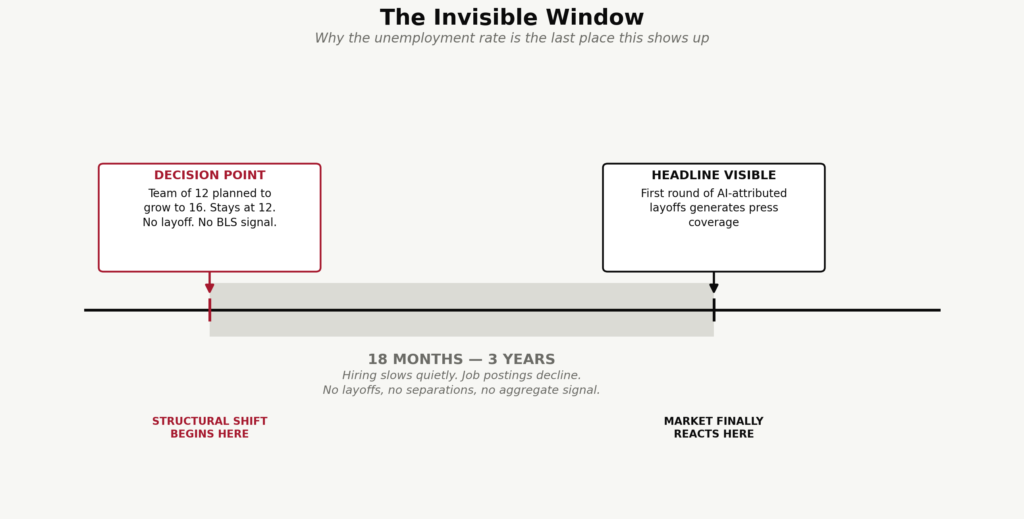
The mechanism that makes the signal invisible in aggregate data during the early phase: when companies first adopt AI to replace cognitive functions, they typically do not reduce headcount immediately. They reduce hiring. A team of twelve that was planning to grow to sixteen stays at twelve. A department adding two junior analysts per year adds zero. The existing headcount attrits naturally through resignations and retirements, unreplaced. This produces no layoffs, no separation events, no BLS-reportable unemployment. The aggregate data shows nothing. Job postings in that category decline which is why Indeed data is actually a better leading indicator than the unemployment rate but even that signal is soft, because the company is not announcing its AI strategy. It is simply not posting roles it used to post.
This phase lasts eighteen months to three years before it shows up in press coverage.
Citrini actually described this mechanism in passing, noting that by October 2026, JOLTS showed job openings falling below 5.5 million, with Indeed data showing white-collar postings collapsing in software, finance, and consulting while blue-collar openings stayed stable. But it was described as a 2026 future event in the fictional timeline, not a 2026 present signal. The piece did not explain how to see it coming before it arrived.
Citadel addressed the current posting data the Indeed chart showing software engineer postings up 11% and treated it as a stable equilibrium signal. It may be. Or it may be the last quarter before the signal turns. The current-moment data cannot distinguish between those two interpretations. Only a transition framework can.
“The unemployment rate is the last instrument you want to use to detect a technology displacement cycle. By the time it moves, you’ve already missed the transition.”
The Thesis, Stated Plainly
So here is the argument this series makes:
White-collar displacement from AI arrives in a sequence that is invisible in aggregate unemployment data, visible in specific leading indicators, and priced by markets last because markets, like the BLS, are built to measure steady states, not transitions.
The sequence begins with middle management and knowledge coordination roles not coders, not creatives, not executives. Middle managers. The people whose primary function is to synthesize information from below, translate it upward, coordinate across functions, and manage the human overhead of organizational complexity. These roles are expensive, numerous, and almost perfectly suited to AI substitution, because the core task information routing and synthesis is precisely what large language models do cheaply and at scale.
From there the sequence moves to junior analyst layers, then to customer-facing white-collar roles with scripted workflows, then much later to roles with genuine creativity, genuine judgment, and genuine relationship dependency. The sequence is not random. It follows the contours of what AI does well today versus what it will do well in three to five years.
Each stage produces a different signal in a different data series. Each stage transmits to corporate margins differently. Each stage carries different implications for asset prices. By the time the unemployment rate clearly reflects displacement, we are at Stage Three or Stage Four of a five-stage process. The investment implications of Stage One and Stage Two are either already priced or they are not and right now, for most of the companies most exposed, they are not.
Citrini described Stage Five. Citadel measured Stage One. The series will map out all five.
Why Both Sides Failed to Look at the Transition
There is a structural reason both sides analyzed the question this way. It is not intellectual laziness. It is architectural a feature of how financial analysis is built.
Financial analysis is designed for equilibrium states. Valuation models take inputs revenue, margins, growth rate, discount rate and produce an output price at a point in time. The scenarios are typically bull, base, and bear: three endpoints, three different steady states. The model does not simulate the path between them. It compares them.
This is fine for most questions. The path between equilibria is usually not the investable thing. But AI displacement is specifically a transition question. The investable signal is in the sequence in knowing which industries show margin compression first, which borrowers in which credit portfolios show stress first, which asset classes reflect the labor share decline before it hits headlines.
Equilibrium analysis produces Citrini’s endpoint. Current-moment empiricism produces Citadel’s snapshot. Transition analysis which is harder, messier, and requires watching the right instruments at the right time produces the actual map.
Citadel ended its piece with a framing question: was the advent of Microsoft Office a complement or substitute for office workers? Ex-ante the concern skewed toward substitution. Ex-post it was a clear complement. The question for this cycle is whether LLMs and agentic tools are closer to Microsoft Office complementary, ultimately expanding the labor market or closer to something genuinely new: a general capability that improves faster than workers can redeploy to the tasks it has not yet reached.
Citrini believes the latter. Citadel believes the former. Both are arguing about the endpoint. The transition tells you which is right and we are in it now.
The February 2026 debate produced twenty-two million views and no usable framework. The data Citadel cited remains accurate. The mechanism Citrini described remains operative. The question neither side answered is the one that matters for every portfolio manager, every private credit analyst, every policymaker, and every professional sitting somewhere in that displacement sequence right now.
You are somewhere in that sequence. Part 2 maps exactly where.